Initial Draft: December 5, 2024 | Updated December 17, 2025
Early detection and consistent monitoring are the foundation of effective glaucoma care. One of the most critical tools supporting that goal today is the handheld tonometer.
Glaucoma is a leading cause of irreversible blindness and often progresses without pain or noticeable symptoms. Many people don’t know they have glaucoma until vision loss has already begun. That’s why ongoing eye pressure monitoring plays such a critical role.
“Glaucoma management depends on understanding pressure patterns over time, not just isolated readings. Handheld tonometry allows us to see what is happening outside the clinic, where most pressure changes actually occur.” – Dr. Barbara M. Wirostko, Moran’s Resident Research Director and Adjunct Professor of Ophthalmology and Biomedical Engineering.
Key Takeaways

Before discussing tonometers, let’s first understand why IOP measurement is critical for glaucoma treatment.
Glaucoma refers to a group of eye diseases that damage the optic nerve. In many cases, this damage correlates with elevated intraocular pressure.
Inside the eye, aqueous humor fluid is constantly produced and drained through the trabecular meshwork. When this drainage system becomes less efficient, pressure builds inside the eye.
Over time, that pressure damages optic nerve fibers, leading to permanent vision loss. The challenge is that glaucoma often advances quietly. By the time symptoms appear, damage has already occurred.
When caught early, treatment can prevent or slow vision loss through medications, laser procedures, or surgery.
The goal of treatment is to lower intraocular pressure (IOP) and prevent further damage to the optic nerve. While you can’t restore lost vision, proper management can preserve your remaining sight for life.
Normal intraocular pressure typically falls between 10 and 21 mmHg. However, “normal” varies from individual to individual. Get more facts about normal eye pressure.
Factors that influence safe pressure levels include:
A reading above 21 mmHg is considered elevated (ocular hypertension) and increases glaucoma risk, though some people with normal pressure can still get glaucoma, and some with high pressure don’t.
According to Allied Eye, an estimated 3 to 6 million people in the U.S. have eye pressure above 21 mmHg, which is commonly considered the upper limit of normal.
The good news? With the right tools, eye pressure is easy to measure and monitor, even at home. Knowing your number early can help you avoid eye disease and irreversible damage later.
Here’s where tonometry comes into play.
Tonometry is the measurement of intraocular pressure (IOP). Because elevated IOP is the most significant modifiable risk factor for glaucoma, tonometry is central to diagnosis and long-term disease management.
Eye care providers use IOP measurements to:
Consistent home testing supports proactive glaucoma management and helps clinicians monitor disease progression more effectively.
Gain more insight by reading Tonometry – A Beginner’s Guide.
Different tonometers serve different purposes. Understanding these differences helps explain why handheld devices play a unique role.
| Tonometer Type | Typical Setting | Primary Strength |
| Goldmann Applanation | Clinic | Clinical reference standard |
| Non-Contact (Air Puff) | Screening | Fast, no contact |
| Handheld Rebound | Clinic and Home | Repeatable trend monitoring |
Goldmann applanation remains the clinical reference standard. However, a handheld tonometer excels at capturing IOP fluctuations over time, which is critical for managing glaucoma outside the exam room.
“Trend data is often more meaningful than a single number. What matters most is how pressure behaves throughout the day.” – Dr. Barbara M. Wirostko, Moran’s Resident Research Director and Adjunct Professor of Ophthalmology and Biomedical Engineering.
One of the most critical concepts in glaucoma care is understanding that eye pressure is not static.
Intraocular pressure naturally fluctuates over 24 hours, often peaking in the early morning and declining during the day. Single clinic readings may miss clinically meaningful pressure spikes.
Generally, eye pressure is highest in the early morning and typically declines during daytime hours. Sometimes, mild increases occur overnight as the chart depicts.

Source: Adapted from published research via PubMed Central (PMC)
The bottom line is that a single office reading represents only one moment in time. Capturing IOP fluctuations helps improve treatment.
These pressure changes are one of the most challenging aspects of glaucoma management.
“IOP fluctuations explain why glaucoma can progress even when office readings look normal. Home monitoring helps fill in the missing hours.” – Dr. Barbara M. Wirostko, Moran’s Resident Research Director and Adjunct Professor of Ophthalmology and Biomedical Engineering.
A handheld tonometer is becoming an essential part of modern glaucoma care as healthcare continues to shift toward earlier detection and home monitoring.
Industry data suggests the global handheld tonometer market is valued between $250 million and $350 million, with continued growth projected through 2033. This growth is driven by an aging population, rising glaucoma prevalence, and increased awareness of proactive eye health management (Data Insights Market).
“Patients today want more insight into their condition. Home monitoring tools help close the information gap between visits.” – Dr. Barbara M. Wirostko, Moran’s Resident Research Director and Adjunct Professor of Ophthalmology and Biomedical Engineering.
A handheld tonometer is a portable medical device used to measure intraocular pressure.
Unlike traditional tonometers, attached to examination equipment in an eye care office, handheld tonometers are lightweight, easy to use, and suitable for use outside the clinic.
Clinicians in exam rooms use some models, while others are approved for use at home by patients.
Their flexibility makes them especially valuable for patients who require frequent monitoring, including those with glaucoma or ocular hypertension.
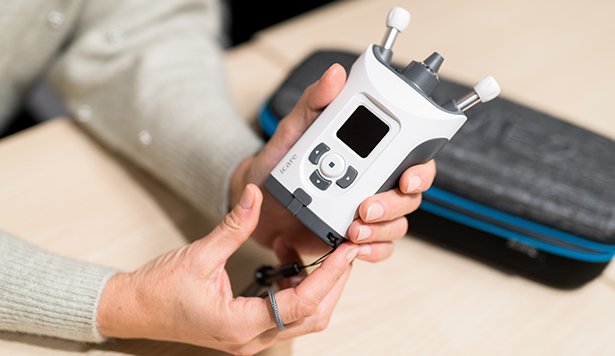
Most handheld tonometers measure eye pressure using rebound technology. A small, lightweight probe briefly touches the surface of the eye and rebounds. The speed of that rebound is used to calculate intraocular pressure.
Because the contact is extremely brief, handheld tonometers typically do not require numbing drops. Many patients describe the sensation as mild or barely noticeable.
“Handheld tonometry makes eye pressure measurement more accessible. It allows pressure monitoring to extend beyond the clinic and into everyday life.” – Dr. Barbara M. Wirostko, Moran’s Resident Research Director and Adjunct Professor of Ophthalmology and Biomedical Engineering.
As mentioned, eye pressure isn’t constant. It changes throughout the day and night, often outside regular office hours.
A handheld tonometer allows patients and clinicians to:
This additional insight supports more informed treatment decisions and proactive glaucoma management.
Accuracy is a common concern when using a handheld tonometer for home eye pressure monitoring.
Goldmann applanation tonometry is the clinical reference standard used in eye care offices. So it’s natural that a handheld tonometer be measured against its benchmark to evaluate performance.
Multiple peer-reviewed studies show that modern handheld tonometers provide readings that closely align with Goldmann applanation, particularly for tracking pressure trends over time.
In a study published in the Journal of Glaucoma, the iCare HOME2 handheld tonometer demonstrated significant alignment with Goldmann applanation tonometry. Readings fell within ±2 mmHg, a range widely considered acceptable for clinical decision-making when monitoring glaucoma.
“Consistency matters as much as precision. When patients measure eye pressure the same way over time, the data becomes clinically meaningful.” – Dr. Barbara M. Wirostko, Moran’s Resident Research Director and Adjunct Professor of Ophthalmology and Biomedical Engineering.
Remember, a handheld tonometer doesn’t replace in-office testing. Instead, it complements clinical exams by capturing pressure changes that occur outside scheduled visits.
Learn more about the accuracy of handheld tonometers.
The cost of a tonometer varies widely depending on the type of device, its intended use, and the features included.
Prices generally range from several hundred to several thousand dollars, depending on whether the device is for clinical use, home monitoring, or advanced diagnostic settings.
| Tonometer Type | Typical Price Range |
| Basic Handheld (applanation or rebound) | $400 to $1,500 |
| Advanced Handheld (clinical-grade) | $1,500 to $4,000+ |
| Non-Contact Tonometers (air puff) | $500 to $6,000+ |
| Slit-Lamp Integrated Systems | $1,000 to $10,000+ |
Note: These ranges reflect broad benchmarks across manufacturers and device classes. Importantly, not all handheld tonometers have the same purpose. Devices built for occasional screening differ significantly from those designed for frequent, patient-led monitoring outside the clinic.
For many patients, purchasing a home tonometer outright can be expensive. Fortunately, some companies offer rental programs that make home eye pressure monitoring more accessible.
For example, MyEyes offers a weekly rental option for its iCare HOME2 handheld tonometer. It costs $249 to rent the device for the initial week, with subsequent weeks costing just $149.
It allows patients to use a handheld tonometer under their eye care provider’s guidance, without the need for a significant upfront investment. This approach gives patients access to meaningful pressure data during critical hours between office visits.
“Home monitoring isn’t about the device itself. It’s about the information it provides and how that information helps protect vision.” – Dr. Barbara M. Wirostko, Moran’s Resident Research Director and Adjunct Professor of Ophthalmology and Biomedical Engineering.
Handheld tonometry gives patients insight into how eye pressure behaves in daily life. That knowledge can support earlier intervention, better treatment decisions, and long-term vision preservation.
When it comes to protecting your sight, the value of timely information often outweighs the cost of the tools used to collect it.
You can’t put a price on your vision.
Understanding the difference between clinic-based and home-based measurements helps explain why handheld tonometers are so valuable.
| Feature | In-Clinic Tonometry | Handheld Home Tonometer |
| Measurement Frequency | Periodic visits | Daily or multiple times per day |
| Captures Pressure Spikes | Typically missed | Frequently detected |
| Environment | Clinical | In-home |
| Patient Involvement | Passive | Active |
| Trend Tracking | Limited | Strong |
| Convenience | Appointment required | At home |
The crux is that home monitoring doesn’t replace clinical care, but rather enhances it.
Using a handheld tonometer is designed to be simple, safe, and comfortable. While your eye care provider will give you specific guidance, most handheld tonometers follow a similar process.

Before taking a reading, sit comfortably and look straight ahead. Good lighting and a steady position help ensure consistent results.
When activated, the handheld tonometer gently aligns with the eye. A small probe briefly touches the surface of the eye and rebounds almost instantly. The contact lasts only milliseconds.
Most people describe the sensation as mild or barely noticeable. Numbing drops are typically not required.
“Patients are often surprised by how quick and comfortable the process is. The design of handheld tonometers removes much of the anxiety around eye pressure testing.” – Dr. Barbara M. Wirostko, Moran’s Resident Research Director and Adjunct Professor of Ophthalmology and Biomedical Engineering.
Consistency is more important than perfection. Eye doctors ask patients to:
These steps help ensure that readings reflect actual pressure patterns rather than moment-to-moment variation.
Handheld tonometers designed for home use often store measurements digitally, making it easier to track eye pressure trends over time.
Some devices, such as the iCare HOME2, also allow patients to securely transmit their eye pressure data to their eye care provider. Data transmission provides clinicians with access to readings collected outside the clinic and at different times of day.
“Seeing pressure data from a patient’s everyday environment gives us a much clearer picture of glaucoma risk and treatment effectiveness. It helps us make decisions based on real patterns, not isolated moments.” – Dr. Barbara M. Wirostko, Moran’s Resident Research Director and Adjunct Professor of Ophthalmology and Biomedical Engineering.
Sharing results digitally allows eye care providers to:
As with any home monitoring tool, patients should follow their provider’s guidance on when and how to share readings and promptly discuss any concerns.
Handheld tonometers shift glaucoma management from reactive to proactive. Instead of relying solely on periodic clinic visits, patients and providers gain insight into how eye pressure behaves throughout the day.
“Home IOP monitoring empowers patients and gives clinicians better information. That combination improves outcomes.” – Dr. Barbara M. Wirostko, Moran’s Resident Research Director and Adjunct Professor of Ophthalmology and Biomedical Engineering.
For individuals at risk for glaucoma or living with the disease, handheld tonometry can play a meaningful role in protecting vision.
If your doctor has recommended closer monitoring of your eye pressure, MyEyes can help. We provide access to handheld tonometers, including rental options, along with guidance to help patients monitor IOP at home and share results with their eye care provider.
Visit MyEyes to learn how home eye pressure monitoring fits into your glaucoma care plan.
How does a handheld tonometer work?
It briefly touches the cornea with a small probe and measures the speed of rebound to calculate eye pressure.
Can you buy a tonometer for home use?
Yes. FDA-approved handheld tonometers are available for rental or purchase through providers.
Is there a home device to check eye pressure?
Yes. A handheld rebound tonometer is explicitly designed for home monitoring.
Which tonometer is most accurate?
Goldmann applanation is the clinical reference standard, but handheld tonometers are reliable for tracking pressure trends.
Does a tonometer touch your eye?
Some do. Handheld rebound tonometers make very brief, gentle contact.
How can I check IOP at home?
With guidance from your eye care provider, a handheld tonometer allows safe at-home monitoring.