For decades, managing glaucoma meant relying on occasional office visits and snapshots of a patient’s intraocular pressure (IOP). But IOP can change throughout the day—sometimes in dangerous ways. Until recently, with the advent of eye pressure machines, those spikes went undetected.
Home-use eye pressure machines are changing that. We’re moving from reactive care to proactive, personalized glaucoma treatment.

IOP measurement isn’t just part of a routine eye exam—it’s central to understanding your risk of glaucoma. Elevated intraocular pressure (IOP) is the number one risk factor for developing the disease. High IOP also speeds the progression of ocular hypertension.
Traditionally, doctors measure intraocular pressure (IOP) using a slit lamp and a tonometer (what is a tonometer). The gold standard is the Goldmann applanation tonometry (GAT) method. It involves applying a small probe to the eye to see the force required to flatten a small part of the cornea. This measures the internal eye pressure.
But there’s a catch: one reading every few months isn’t enough.
Office-based IOP checks provide an assessment of your eye health at that moment. However, pressure can fluctuate wildly based on factors such as time of day, posture, medication, or even stress. Many glaucoma patients experience damaging spikes when they’re not at the clinic.
Even advanced tools like air puff tonometry or dynamic contour tonometry can’t catch those changes unless they’re used frequently. Additionally, factors such as corneal thickness can impact accuracy. That makes it even more critical to track IOP consistently over time.
That’s where home-use eye pressure machines come in.
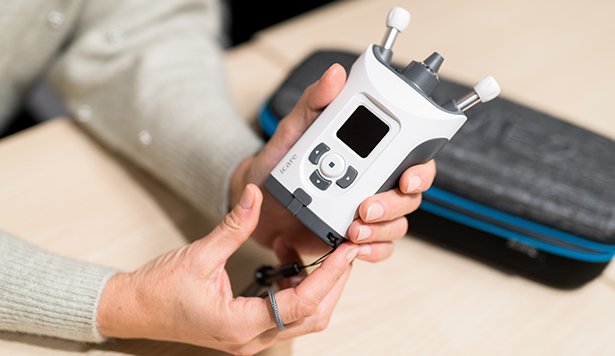
Modern devices, such as the iCare HOME2, use rebound tonometry. This newer type of tonometry doesn’t require eye drops or a professional to administer. Using the home eye pressure machine is quick, portable, and comfortable.
Instead of using a puff or touching the eye with a tonometer tip, it uses a small probe. This probe gently bounces off the surface of the eye.
Because it’s non-invasive and easy to use, patients can take readings multiple times a day without discomfort. These machines are FDA-approved and clinically validated, giving eye doctors real data they can trust.

You can rent an eye pressure machine, such as the ICare HOME2, for one week for $249. Subsequent weeks cost $149. This short-term approach lets you measure eye pressure at home. You don’t have to worry about frequent clinic visits, saving time and hassle.
For a longer-term solution, you can also purchase the tonometer for $2,995.
Continuous or regular IOP measurement at home means:
Measuring IOP isn’t just about numbers—it’s about outcomes. The ability to measure eye pressure regularly helps reduce the risk of optic nerve damage by enabling faster intervention and treatment.
And because many patients don’t feel high IOP (until vision loss occurs), these machines offer peace of mind. They alert users and doctors before damage is permanent.
While an eye pressure machine is powerful, it’s only one piece of the puzzle. A complete glaucoma assessment also includes:
Still, when combined with traditional exams, home eye pressure tracking enhances care and helps patients become active participants in their care.
Not every glaucoma patient needs one. For people with serious illnesses, a handheld tonometer can be helpful. This is especially true if they have changing eye pressure or worsening vision, even with treatment.
Some doctors even recommend them for people with ocular hypertension, before glaucoma develops. Early intervention is the best defense against permanent vision loss.
Devices like the iCare HOME eye pressure machine have already shown promise, but new solutions are emerging. Innovations like the ocular response analyzer, which evaluates the cornea’s biomechanical response to pressure, and smart contact tonometry sensors are on the horizon.
MyEyes is helping to lead this shift toward smarter, more responsive glaucoma care. Its platform integrates user-friendly technology, secure data sharing, and personalized IOP tracking. It was designed for real patients, not just eye care professionals.
Whether you are managing stable glaucoma or checking for pressure spikes, MyEyes gives you control over IOP measurement.
Glaucoma doesn’t wait between appointments. The ability to track eye pressure at home revolutionizes how doctors treat and how patients manage their condition. Eye pressure machines are no longer optional tech gadgets. They’re essential tools in modern eye care.
If you have glaucoma, talk to your doctor. Ask about incorporating a home eye pressure monitor into your care plan. You might catch the spike that saves your sight.